


Commercial Pavilions: Give Your Outdoor Space a Reason to Get Used, Rain or Shine
An outdoor space only earns its keep if people actually use it. Restaurants know this every time a rainy forecast empties a patio. Event venues know it when a beautiful outdoor ceremony space sits unused for half the year. Municipalities know it when a park's green space looks great but rarely draws a crowd. A well-built commercial pavilion solves that problem directly — turning an outdoor area into space people can rely on, regardless of weather or season.
Drift Creek Company builds custom commercial pavilions for exactly these situations: municipal parks, restaurant patios, event venues, and beyond. Here's what sets a commercial pavilion apart from a standard backyard build, and how to think through the decision for your organization.
Why Commercial Pavilions Matter for Restaurants, Venues, and Municipalities
Each type of organization gets something a little different out of a commercial pavilion:
Restaurants extend seating rain or shine, protecting revenue that would otherwise disappear the moment weather turns.
Event venues add a signature gathering spot — a covered space that becomes part of how the venue is remembered and booked.
Municipalities give their community a place to actually use shared outdoor space, year-round rather than seasonally.
In each case, the pavilion isn't just a shelter — it becomes a functional extension of how the property operates day to day.
What Sets a Commercial Pavilion Apart
A commercial pavilion isn't simply a larger version of a backyard structure. It's designed from the ground up around different demands: more people, more frequent use, and higher expectations for durability. A few things that distinguish a true commercial build:
Built for Real Traffic
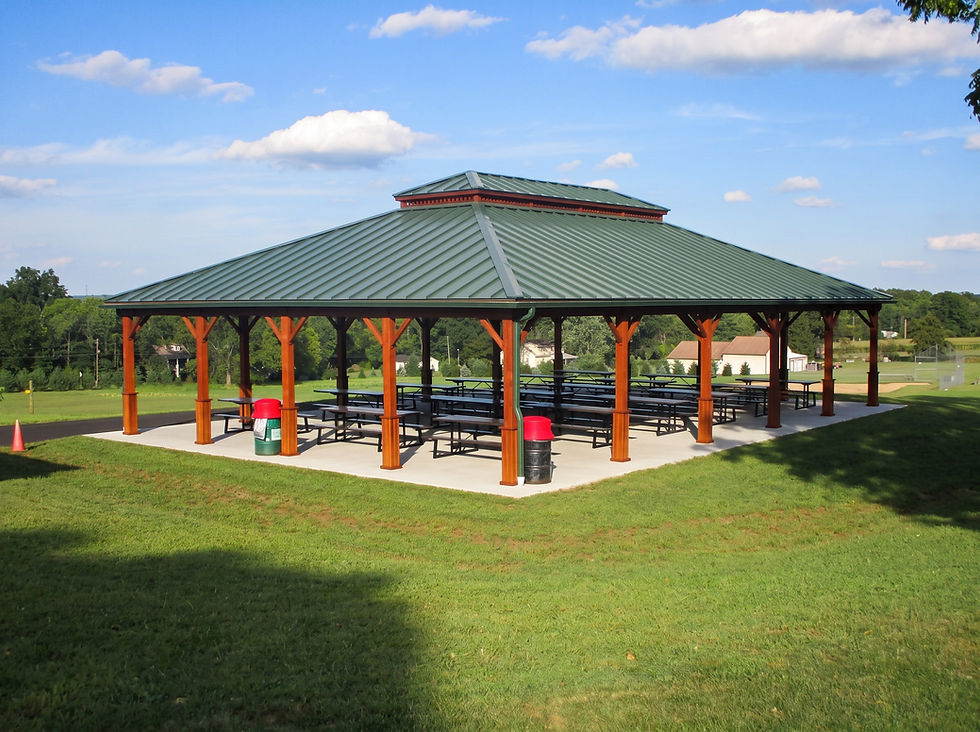
Commercial pavilions are designed with larger footprints suited to group seating and high foot traffic — not scaled-up backyard dimensions. That means thinking through circulation, seating capacity, and how people will actually move through the space during busy hours or peak events.
Durable, Low-Maintenance Materials
A commercial pavilion needs to hold up to frequent, everyday use, not just look good on day one. Material and finish choices for commercial builds are selected with that in mind — built to withstand consistent traffic, weather exposure, and the wear that comes with regular public or customer use over years, not just seasons.
Flexible Layouts
Whether the space is used for event hosting, dining, or general community gathering, a commercial pavilion's design should adapt to how the organization actually operates — not force operations to adapt to the structure. That might mean open sightlines for event flexibility, dedicated dining zones for a restaurant patio, or a layout built around how a park typically gets used throughout the day.
Modular or Fully On-Site Construction
Commercial pavilions, like our residential builds, are available as either:
Modular construction — built off-site and delivered, offering a faster timeline with less disruption to an active business or public space during construction.
Fully on-site construction — built directly on location, allowing for maximum scale and custom architectural matching to existing buildings or surroundings.
For a restaurant or venue that can't afford extended downtime, modular construction often makes the most sense. For a municipality or large-scale project prioritizing a specific architectural look, an on-site build offers more flexibility to get there.
Design That Reflects Your Brand or Community
From a brewery patio to a municipal park pavilion, the structure becomes part of a property's identity — not just a roof overhead. A commercial pavilion is one of the more visible investments an organization makes in its outdoor space, which means design choices (rooflines, materials, finishes) should reflect how the organization wants to be seen, not just what's functional.
Commercial Pavilions in Practice
Restaurants and breweries use commercial pavilions to reclaim patio seating that would otherwise sit empty on rainy or overly sunny days — protecting revenue that depends on covered outdoor capacity.
Event venues rely on commercial pavilions as a signature, weatherproof gathering space that can host ceremonies, receptions, and other events without being at the mercy of a forecast.
Municipalities use commercial pavilions to activate park space year-round, giving residents a covered spot for community events, family gatherings, and everyday use that wouldn't happen without shelter from the elements.
Across all three, the pattern is the same: a commercial pavilion converts an outdoor space from occasionally used to consistently used.
How to Think Through a Commercial Pavilion Project
If you're evaluating a commercial pavilion for your property, a few questions are worth working through early:
How many people does the space need to accommodate at peak use? This shapes footprint and layout more than any other factor.
How disruptive can construction be to daily operations? This often determines whether modular or on-site construction is the better fit.
Does the structure need to match existing architecture? On-site builds allow for closer matching; modular builds prioritize speed and simplicity.
What's the long-term maintenance plan? Choosing durable, low-maintenance materials upfront reduces the burden of upkeep for years of heavy use.
Answering these questions early makes the design and construction process considerably smoother once a project moves forward.
Frequently Asked Questions
What's the difference between a residential and commercial pavilion?Commercial pavilions are built with larger footprints, higher-traffic-rated materials, and layouts designed around group use — restaurant seating, event hosting, or public park gathering — rather than typical backyard use.
Should a restaurant or venue choose a modular or on-site commercial pavilion?Modular construction typically offers a faster timeline and less disruption, which matters for a business that needs to stay operational during construction. On-site builds are better suited to projects prioritizing maximum scale or close architectural matching.
How much does a commercial pavilion cost?Cost varies based on size, materials, and site conditions — a modular pavilion built for a smaller restaurant patio costs significantly less than a large custom, on-site municipal park pavilion. Requesting a free quote is the most accurate way to get pricing for a specific project.
What areas does Drift Creek Company serve for commercial pavilion projects?Drift Creek Company serves organizations across Massachusetts, Rhode Island, Connecticut, New York, New Jersey, Pennsylvania, Delaware, Maryland, West Virginia, and Virginia.
Start Your Commercial Pavilion Project
Whether it's a restaurant or venue pavilion designed to protect outdoor revenue rain or shine, or a municipal pavilion built to give a community a year-round gathering space, a commercial pavilion is custom-designed, built to last, and tailored to how your business or community actually operates.

Ready to start your project? Get a commercial pavilion quote or call (570) 390-1445 / email Info@DriftCreekCo.com to begin.
Drift Creek Company builds and delivers custom commercial pavilions, along with residential outdoor structures, throughout Massachusetts, Rhode Island, Connecticut, New York, New Jersey, Pennsylvania, Delaware, Maryland, West Virginia, and Virginia.



Comments